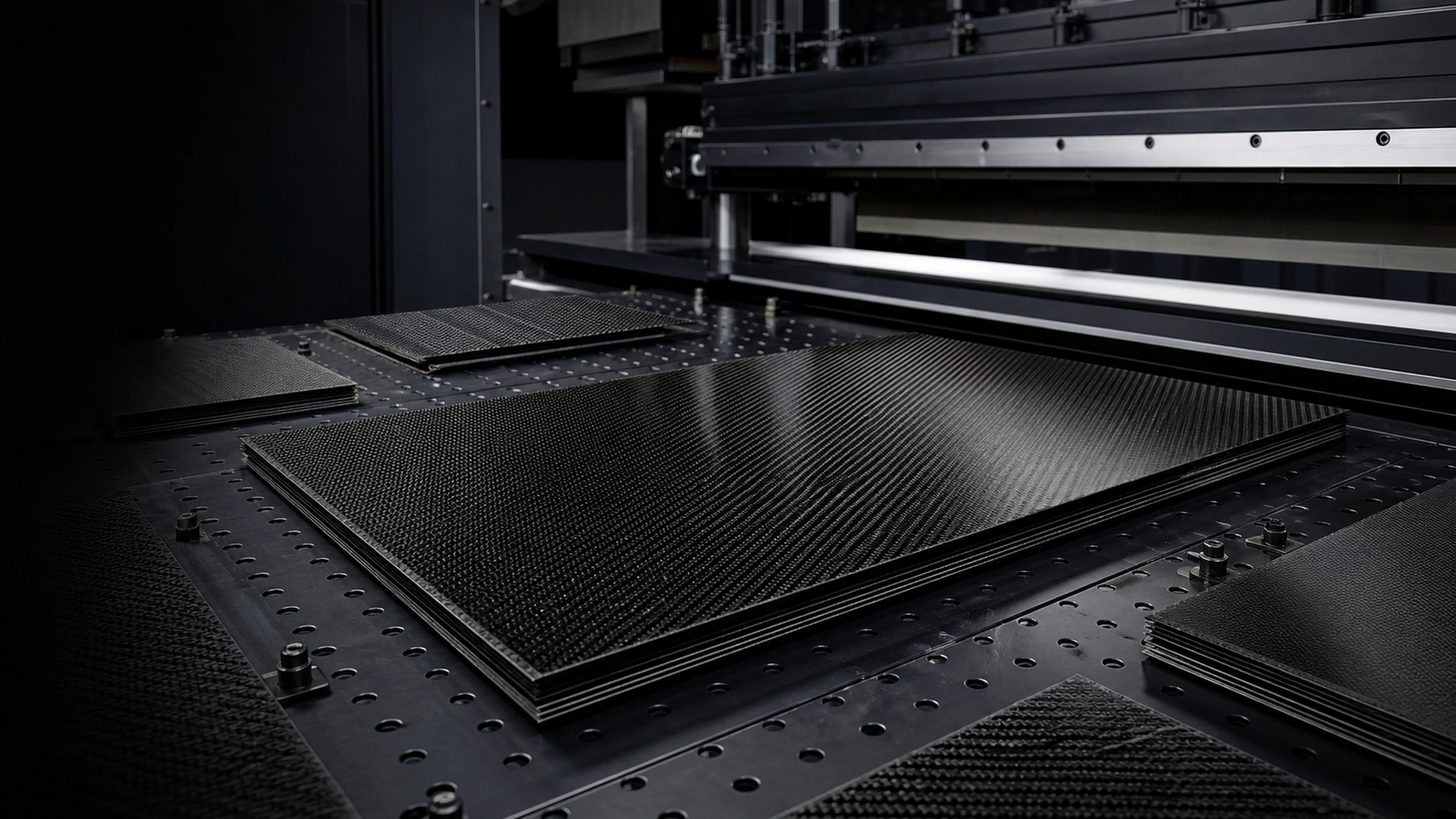
A sheet starts with the requirements of the finished part. Size and thickness describe its geometry; fibre orientation and the resin system determine how the material behaves in a structure.
Discuss sheet blanks for cutting, assembly or subsequent CNC machining. Separate essential requirements from preferences: for example, specify a thickness needed for assembly separately from the surface weave pattern.
Size
Blank length and width; specify finished part dimensions and machining allowances separately.
Thickness
Nominal thickness, permitted deviations and areas where thickness affects assembly.
Layup
Reinforcement and fibre orientation requirements, where specified by the design.
Surface
Visible face, weave pattern, reverse-side appearance and subsequent coating.
02 / PROCESS
How a sheet blank is made
This is a general sequence for manufacturing laminated carbon composites. The specific layup and process route depend on the material and project requirements.
Process illustration
01
Select reinforcement and resin
A sheet consists of reinforcement layers. Their type and orientation are selected for the application. The visible weave shows only the surface: a photograph cannot reveal the full layup or establish the properties of the finished sheet.
02
Assemble the layup
Layers are arranged in the specified sequence. With prepreg, resin is already present in the reinforcement. The layer count and stacking sequence belong in the material specification; appearance alone does not determine them.
03
Mould and cure
The prepared layup is moulded and cured according to the selected system. Temperature, time and pressure cannot be transferred between resin systems without checking the documentation.
04
Prepare the sheet for further work
After moulding, the blank is finished to the agreed size and checked against the specification. If parts will be cut from it, machining allowances, thickness and requirements for both surfaces are considered separately.
From sheet to part with clear requirements
Panels, brackets and assembly components require different specifications. Send the intended application and a drawing if available. Mark holes, cutouts and joints to connect material selection with subsequent machining. Replace a general request for the strongest carbon with verifiable operating requirements.
Thickness is one geometric parameter. Useful selection also requires the application, size, surface requirements and reinforcement layup where specified. Two similar-looking sheets are not necessarily interchangeable.
When should I discuss CNC cutting?+
Send the part geometry with your sheet enquiry. The material and machining requirements can then be agreed separately. Pre-series part samples are covered in the CNC section.
04 / ENQUIRY
Prepare your project details
Send the sheet size, thickness, quantity and application. Attach the finished part drawing if cutting is required, and identify the acceptance criteria.