Define the section and its function
The specification records shape, length and loading conditions. Solid and hollow sections are considered separately. Fastening and load-transfer areas may have different requirements from the free span.
 +7 499 666-62-43
MANUFACTURING · TUBES AND RODS
Hollow tubes and solid rods serve different structural purposes. Profile selection requires the section, length and load directions to be considered together with its internal structure.
Discuss tubes and rodsHow the process works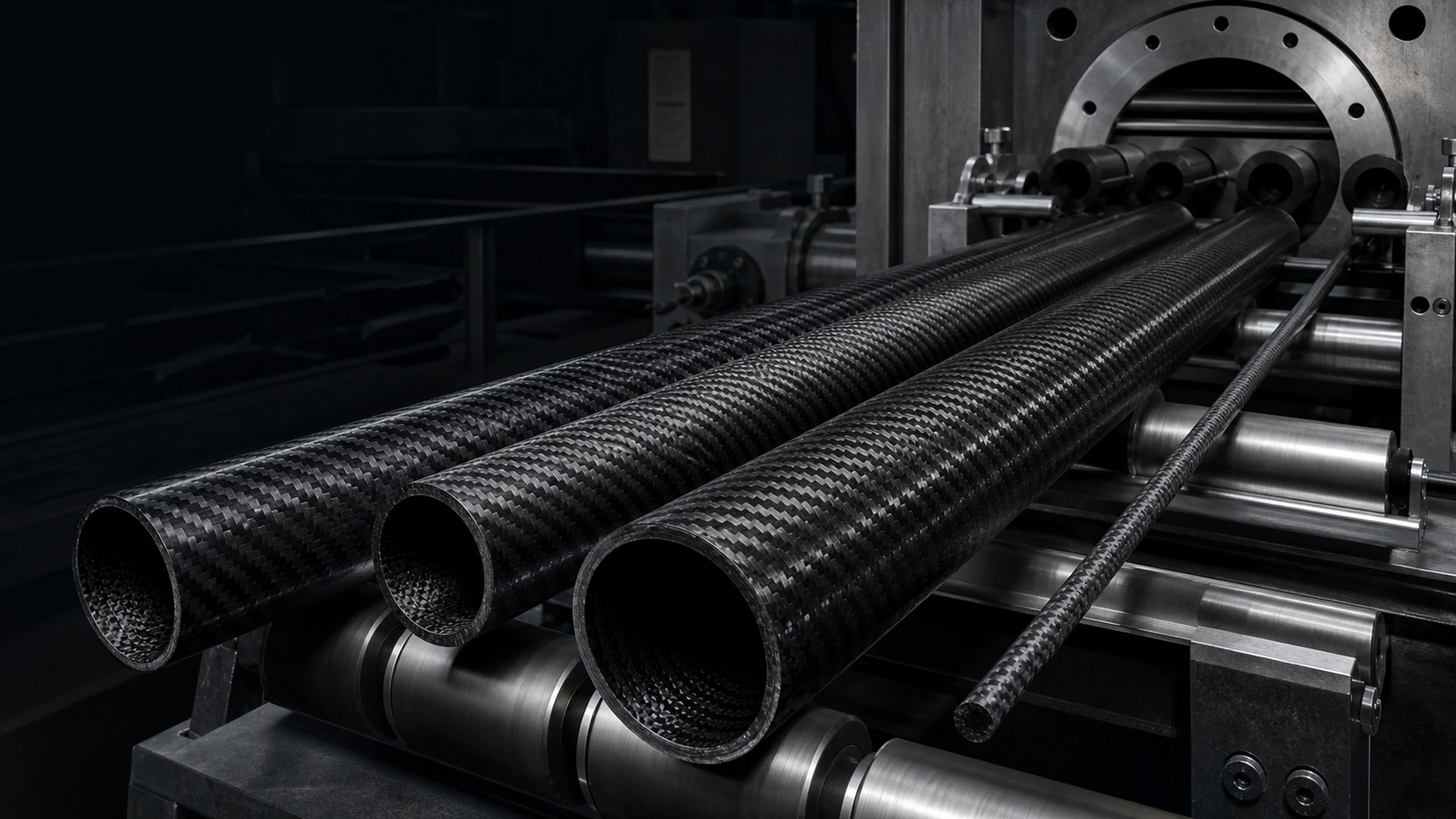
01 / YOUR PROJECT
Start with where the profile will be installed and how it connects to adjacent parts. A tube's outside and inside dimensions both matter; one diameter leaves the geometry ambiguous.
02 / PROCESS
Pultrusion and winding are general methods of producing composite profiles. Availability of a particular route for your geometry is confirmed during project discussions.
The specification records shape, length and loading conditions. Solid and hollow sections are considered separately. Fastening and load-transfer areas may have different requirements from the free span.
Longitudinal fibres run along the axis. Additional reinforcement in other directions changes the profile structure. The outer pattern and the word carbon alone do not describe a tube's behaviour in bending or torsion.
In pultrusion, impregnated reinforcement is pulled through heated forming tooling. Winding processes additionally place fibres around the axis. The choice depends on the required structure, not just the outside diameter.
The continuous profile is cut to specified lengths. Requirements for ends, mating areas and permitted deviations are recorded separately. Agree any additional machining before ordering.
If a tube fits into a sleeve, is clamped or joins another profile, show that area in a drawing. One overall dimension is insufficient to assess the fit. For repeat orders, retain the material designation and document revision: visually identical blanks may have different internal structures.
Exel Composites: pultrusion and combined winding03 / QUESTIONS
A hollow tube also needs an inside diameter or agreed wall thickness. Add length, quantity and fit requirements. For a non-circular profile, attach a dimensioned cross-section.
A designer must assess the substitution against loads and fastening methods. Equal outside dimensions do not give solid and hollow profiles the same behaviour in an assembly.
04 / ENQUIRY
Send a cross-section drawing, length, item list and quantities. Show connections and describe what the profile must withstand or achieve in your structure.
Submit your projectQUICK RESULTS